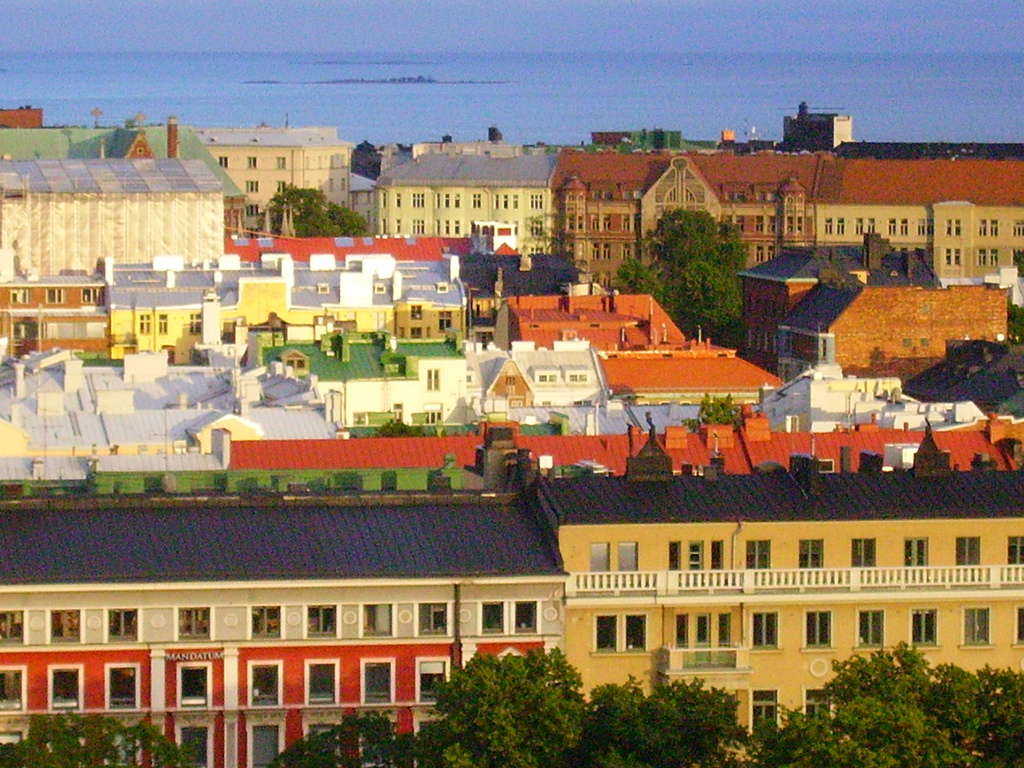
There is a playground nestling in the near corner of the woods known as Keskuspuisto, the central park, although it is not really a park at all. It is woodland, and it stretches out and joins other woods and eventually becomes the taiga forest that continues until Lapland, until the latitudes where trees give up, finally leaving behind just ankle-high, twisted, die-hard brothers of the silver birch. The playground is on dry pinewood moorland, the pines are tall and straight and beautiful with their red trunks, all bathed in the faded golden of light of summers long ago.
A is very young, perhaps three years old.
As in all her memories, she is both the rememberer and the remembered, but in this one, very strongly so. She is three years old, let's say, because it is as close as needs to be. Three years old, and it is golden summer.
She is little, she knows this. She is little but as yet somehow invincible, sprung like a bow and arrow, simultaneously arching, aiming, firing, and hitting life. She knows the world was put there for her. She knows her cousin is there to look after her and be with her while her mother works on her studies - her "gradu", graduation piece, so central a word in the daily vocabulary of her world she too works on her own "gladu". Her r's don't roll yet, but as yet, she knows this doesn't matter. Her mother gives her the cardboard backing from one of her graphed notepads, and she folds it in half and writes her gladu on it in yellow crayon. She is still very little, she the rememberer knows this, because at four she began writing stories others could read too, and her gladu is just yellow zig-zag.
Yellow zig-zag across the pages of her gladu, line after line. She the remembered looks at her gladu and feels a dawning understanding of it being just yellow zig-zag. There is an unsettlingness in this understanding, the precursor to the desperation she will learn to experience later.
There is a golden day out in the playground by the woods. The most fascinating of the playground toys is an assortment of wooden blocks, painted in chipped and faded green, or yellow, or red, the size of bricks, stored in a big lockable playground toy box. The big boys stand them up, one after another, making winding, snakey rows of them, finally knocking the last one over and setting them all tumbling down, domino-like. A longs to play this, too, but there is no possibility of ever joining in. It is what the big boys do, and she is three years old, and a girl, with plaits long enough to sit on. A and her big cousin, fourteen years old, play and talk. A worships her cousin. She is not a grown-up, but neither is she a child, yet she plays and talks with A and doesn't laugh at what she says.
How it comes about is lost to she the rememberer, and she the remembered cannot tell. One of A's plaits comes undone - the ribbons of the late sixties come loose easily, especially from sleek, slippery hair on lively heads. There is a policeman at the playground - why, she the remembered doesn't ask, and she the rememberer doesn't know - mere coincidence, no doubt, yet it is this coincidence which creates the memory, ensuring the golden day on the playground doesn't disappear and melt into and become one with other golden days on other playgrounds. A and her cousin approach the policeman and ask him for help. The colours are faded in the beautiful manner of sixties-seventies colour photographs, when the policeman plaits A's hair in the playground by the woods. A sees his blue uniform jacket and bright buttons. She knows the world was put there for her, with policemen to plait her hair at playgrounds.
Thursday, June 28, 2007
The playground, the plaits, the policeman

Tuesday, March 27, 2007
A Mind Most Austerly
A loves observing the life of others from her vantage point on the tenth floor. People rarely look up to see her spy upon them. One day, she spots a foreign family from her building - they are French-speaking - she has met the father and daughter before, they've taken the same lift up. The family is out on one of the footpaths outside her building, the parents, one at each end of a skipping rope, twirling it for their daugher - eightish, in a pink cap - to skip. Without warning, A's heart is stabbed by recognition, understanding, memories, sadness, pain, the beauty of life. She feels, all the way up to her balcony, their collective loneliness - in a strange country, no family, no family friends, who else would twirl the rope - as well as their heart-breaking resolve to remain brave, upbeat: so what that our daughter has no-one to skip with, no-one to twirl the rope for her, we'll twirl it for her ourselves, now that the evenings are already lit with the unbearable beauty of the white nights that await us, our daughter will have the experience of having skipped rope all evening when she was eight and wore a pink cap.
Saturday, March 03, 2007
The mind is blowing Austerly
I recently read my first Paul Auster book, "The Invention of Solitude".
Confessions time: I have suffered from an attitude against American writers. Like, "they cannot be all that literary (=good) since they are American". Shame on me. The book is brilliant, particularly "The Book of Memory", its second half. Somewhere towards the end, the narrator (who tells us he decides to call himself A and speak of himself in the third person) launches into a page-long desperate attempt, as it were, to remember everything in his life, sentence upon sentence, a breathless and beautiful list.
The sequence is stunning to me, as I too am an A and have since childhood had both the need to remember and the habit of referring to myself in the third person in my thoughts. And this is what came out of it:
She remembers reading Paul Auster's book and loving it. She remembers recognising the need to verify all her life's moments by remembering, by recording them. She remembers deciding she would write a blog entry, this one, in its style, copying openly and shamelessly. She remembers, at age four or thereabouts, the magic night of a floating star, which probably was a satellite, her first. She remembers falling asleep in the boat when it got stuck in shallow water and being carried home and jolted awake, just slightly, by her father taking an unsteady step going down that hill. She remembers the black kitten she got for her fourth birthday, wrapped up in a purple sweater. She remembers the Baltic of her childhood, a beautiful benign entity, and its granite shores. She remembers loving the tadpoles she studied every summer in their rock pools. She remembers her mother pointing out how fir trees in the distance look blue in winter. She remembers how she cried when the big fir tree at the cottage had been felled over the winter. She remembers skating and skiing and the smack she got from her father when she tried to make snowballs without her mittens. She remembers the clay landscapes she made to represent Anne of Green Gables' Avonlea. She remembers going to school and loving it. She remembers going to school and hating it. She remembers boys and men and getting married and getting divorced and having babies. She remembers the look of wonder on her firstborn's month-old face when he first noticed the green summer branches swaying above him. She remembers the existential shock she got from his first smile. She remembers giving birth. She remembers her younger being scared of the dark when he was too young to be scared of it, and his hiccupy contagious laughter. She remembers building a tower with her toddler's nestling pots and understanding, preverbally, that she'd got it right. She remembers going to a session of some therapy whose name, ridiculously, she has forgotten, and there remembering being born. She remembers she never told anyone about that. She remembers her psychoanalyst and not wanting to talk to her for four years. She remembers the set of four or five nesting pottery eggshells she gave her as a good-bye present. She remembers, as a two-three-year-old, dreaming twice that a lorry came to fetch her from the park and that it kissed her on the knee. She remembers things so piss-awful she refuses to remember them, and things so nasty she refuses to forget them. She remembers living on the other side of the planet and starting this blog. She knows if she wanted and tried to, she would remember everything. She would, she would, she would.


